Why your website traffic is down this year: Google's AI Overview
The firm still ranks first for every practice term it ranked for a year ago, and organic traffic is down anyway. Nobody touched the site. The clients simply stopped arriving. They got their answer at the top of the page, in a box the firm did not know was there.
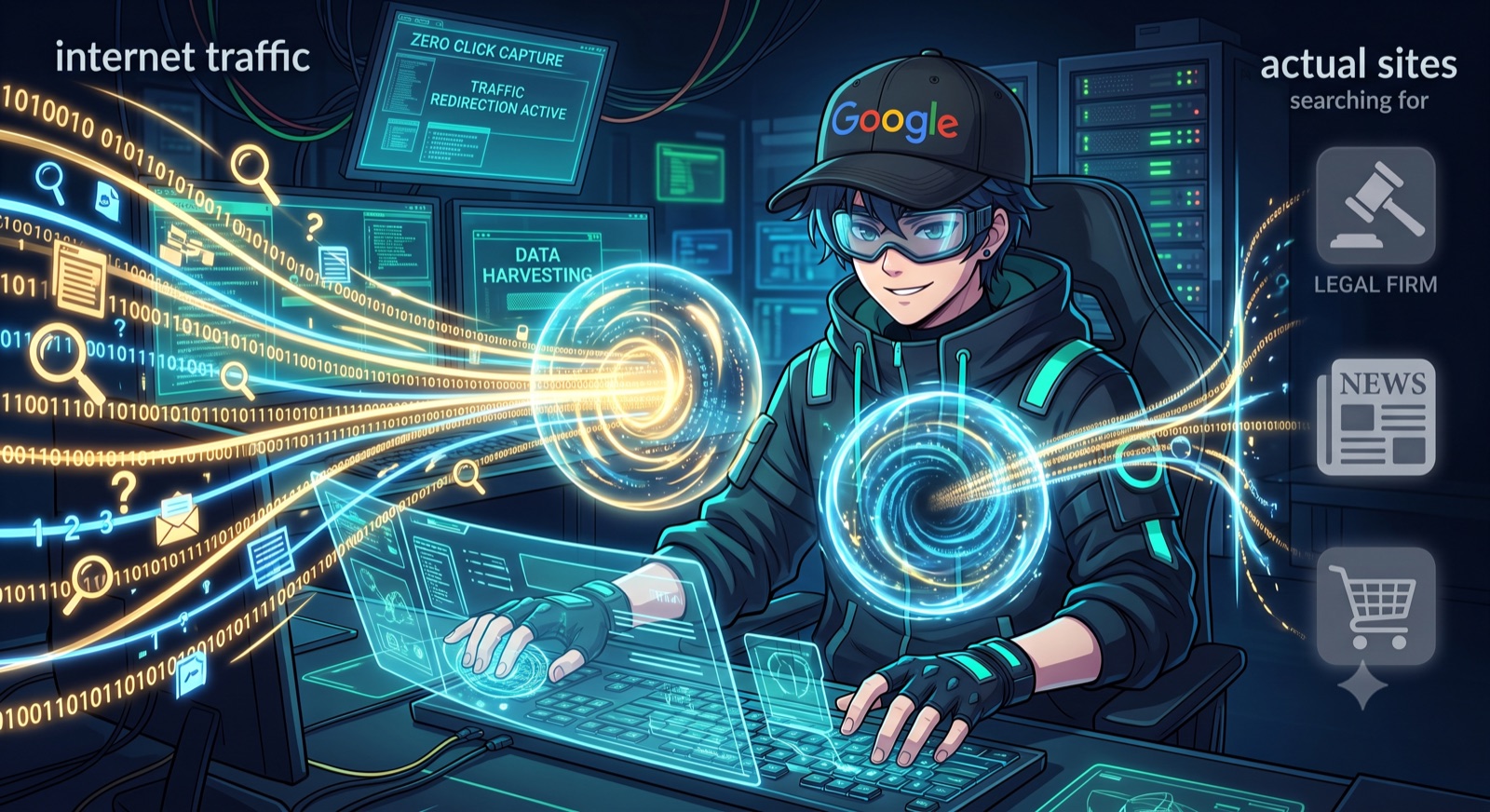
Picture a marketing director at a litigation firm pulling up the SEMrush report before the quarterly review. Every ranking is still there. First position on Google for the top practice terms, same as a year ago. And organic traffic to the firm's website is down anyway.
The same drop is showing up across the industry. In the first months of 2026, 68 percent of US Google searches ended without a single click to any site. The traffic stopped somewhere no SEMrush report will show her: the top of Google's own page, inside a box that answered the question before her firm ever came up.
That box is Google's AI Overview. It now sits above the search results on a large share of US searches. To see how a firm wins every ranking and still loses the client, you need to know what that box is, where it came from, and how it decides which firms it names.
The box that grew up in three years
Google previewed this in May 2023 under the name Search Generative Experience, buried behind a Labs waitlist that most people never joined. It was presented as an experiment.
In May 2024, Google put AI Overviews live for everyone in the United States. By that October it reached more than 100 countries. By 2025 it ran in over 200 countries and more than 40 languages, and in early 2026 Google moved it onto its newest model, Gemini 3. Google has said the feature reaches more than 2.5 billion people a month.
In three years the answer box went from a hidden trial to the first thing a large share of the world sees when it searches. For most firms, that shift happened in the background of a marketing plan that still treated Google as a list of ten blue links.
The traffic that never leaves the page
When the box answers the question at the top of the page, the search often ends right there. The person got what they came for and closed the tab.
The numbers behind this are recent. In a controlled 2026 study, researchers at the Indian School of Business and Carnegie Mellon tracked real Google users for two weeks. When the answer box appeared, clicks to the sites below it dropped by nearly 40 percent. Searches that ended without anyone leaving Google rose from 54 percent to 72 percent.
Pew Research Center found the same pattern in July 2025: with an AI summary on the page, users clicked a result in 8 percent of visits, against 15 percent without one. When the box shows up, the click does not follow. Ranking first on Google, the position firms spent years and budgets to win, no longer means the client arrives. More often it means the client reads the answer and never scrolls to the name below it.
Google's answer, and why it does not cover law firms
Google does not accept the word "theft," and to its credit it has a real argument. At its 2025 developer conference, Sundar Pichai said AI Overviews drove about 10 percent more searches in the query types where the box appears, in both the US and India. Liz Reid, who runs Search, frames it the same way: the box kills low-value "bounce" clicks, the ones where someone grabbed a fact and left anyway, and pushes higher-quality "deep clicks" to richer pages. People search more, the argument goes.
For a recipe or a weather question, that logic holds. For a law firm, the deep click never comes.
When someone searches for a lawyer, the box names a few options, and the trail of trust it leaves behind does not lead to your website. In legal search, that trail leads to a directory.
How the box decides which firms it names
The signals that get a page cited inside an AI Overview are different from the signals that rank it. A page can sit at position one and never appear in the box. A page can sit lower and get named, because it states a clear answer the model can lift and trust.
For legal questions, the sources it trusts are startlingly few. A 2026 study from 5WPR and the Haute Lawyer network found that seven directories own nearly every AI citation across legal query categories: Chambers, Legal 500, Super Lawyers, Best Lawyers, Martindale, Avvo, and Justia. When a person asks Google who the best firm is for their problem, the answer is assembled out of those seven names. Individual firm websites, including the most decorated firms in the country, sit below all of them.
So the firm faces two doors, and both are shut. The searcher never clicks through to the site, because the box answered them. And inside the box, the firm shows up, at best, as one line on a directory page rather than as the recommended voice. Ranking first on Google protects neither.
What the silence costs, in cases
Run the math for your own firm. Take the share of new matters that start with a Google search, apply the nearly 40 percent click loss from the study above, and multiply by your average matter value. Legal questions trigger the box more often than the average search: 23.6 percent of legal queries, against 20.5 percent of all queries, according to Ahrefs in November 2025. The matters that never start come from clients who found their answer and never learned the firm existed.
The deeper cost is the moment. The first picture a client forms of who is good at their problem now forms inside the answer box, before they speak to anyone. A firm absent from that box is absent at the exact second the shortlist is written. By the time it would have had a chance to compete, the competition already happened, and it was not invited.
What a firm can do to show up in the answer
A better website on its own does not fix this. The box builds its answer out of the sources it already trusts, so the work is to become one of those sources and to be the named firm inside the answer. No one controls what Google's model says. A handful of moves shift the odds.
Get into the sources the box pulls from. For legal questions, those are the directories that own the citations: Chambers, Legal 500, Super Lawyers, Best Lawyers, Martindale, Avvo, Justia. Claim every profile, complete it fully, and keep it current. A firm absent from the sources the box reads is absent from the answer it writes.
Answer the question on your own pages, in plain words, up top. The box lifts clear, self-contained answers. A page that states the answer to a real client question in its first lines, with the firm named as the source, is far easier to cite than one that buries the point under a brand story.
Keep the firm's identity identical everywhere. Same name, same practice areas, same locations, same attorney details across the website, the directories, and every profile. Conflicting information makes a firm harder for the model to trust, and trust is what gets a firm named.
Earn mentions in the places the model reads. References, bylines, and coverage in legal publications and other trusted third-party sources give the model evidence a firm's own site cannot supply. This is the work that moves a firm from mentioned to recommended.
Measure what the answer says today, engine by engine, and correct what is wrong. The box makes claims about firms, and sometimes it gets them wrong. Knowing exactly what it says about your firm right now, across each platform, is the starting line for fixing it.
This is a different discipline from ranking. Ranking put your page in a list and left the choice to the client. The answer box makes the first cut itself, from the sources it trusts, before the client sees a single link. The firms that appear there are the ones the box has evidence for. Everything above is how a firm gives it that evidence.
Sources: SparkToro, using Similarweb clickstream data, 2026 (zero-click share of US Google searches); Saharsh Agarwal (Indian School of Business) and Ananya Sen (Carnegie Mellon), pre-registered randomized field experiment, January to February 2026 (click and zero-click effects of AI Overviews); Pew Research Center, July 2025 (click rates with and without an AI summary); Ahrefs, November 2025 (share of legal queries that trigger Google's AI answer); 5WPR and Haute Lawyer, 2026 Legal AI Visibility Report (legal AI citations); Sundar Pichai, Google I/O 2025 and 2026 (rollout, reach, and searches); Liz Reid, Head of Search, 2025 to 2026 (Google's position). AI Overview rollout timeline via Google I/O announcements.
Frequently asked questions
No. The signals that get a page cited in an AI Overview are separate from the signals that rank it. A firm can hold the number-one position and never appear in the box, because the box names the sources it trusts, and for legal questions those are directories rather than firm websites.
A 2026 study by 5WPR and the Haute Lawyer network found seven directories own nearly all AI citations for legal queries: Chambers, Legal 500, Super Lawyers, Best Lawyers, Martindale, Avvo, and Justia. Individual firm sites rank below them.
A 2026 field experiment found that AI Overviews cut clicks to the sites beneath them by nearly 40 percent, and pushed zero-click searches from 54 to 72 percent. On many searches now, the search ends inside the box.
Yes. Because the answer is built from a defined set of trusted sources, a firm can work to become one of them and to be named directly inside the answer. That work is Answer Engine Optimization, and it is what Selectio does for law firms.
See what the answer box says about your firm
Your free, live AI visibility check runs the questions your clients ask and shows you exactly where your firm stands across ChatGPT, Perplexity, Gemini, Claude, and Google's AI Overviews, and which firms get named instead.
Run your AI visibility check